
Saves Time and Accelerates Graduation
You don't lose the months or years you spent on completed coursework. You only take the remaining subjects needed to fulfill the target degree requirements.
Share a few details to explore your academic options.
Inter-University B-Tech Credit Transfer allows a student to request that academic credits earned at one university or higher education institution count toward a degree programme at a different university.
Instead of starting a degree over from scratch, your target university reviews the subject material and credit value of your completed courses. It may accept eligible subjects and permit entry into a later stage of the programme, subject to its policies and applicable requirements.

You don't lose the months or years you spent on completed coursework. You only take the remaining subjects needed to fulfill the target degree requirements.
Transferring credits eliminates the need to pay tuition fees for subjects you have already completed and passed.
If you need to move due to family relocation, job shifts, or personal reasons, Academic credit transfer allows you to continue your education seamlessly without dropping out.
Under frameworks like NEP, students can pursue courses across different institutions (including authorized online platforms like SWAYAM or NPTEL) to customize their degree based on interest.
Students who had to discontinue their B-Tech studies, or who failed specific b-tech backlogs elsewhere, can transfer valid cleared credits to finish their degree under a new curriculum.
For Engineering degree
The exact administrative procedure varies depending on whether you are using a national credit repository (like India's ABC system) or applying through direct institutional credit evaluations.
Free phone consultation
Collect official documentation from your current (or previous) university:
The university's Academic Equivalency Committee evaluates your past subject credits.
The university issues a Credit Exemption/Equivalence Letter outlining:
Formally accept the credit transfer offer, complete enrollment procedures, and register for the remaining requirements of your degree program.

Itanagar, Arunachal Pradesh
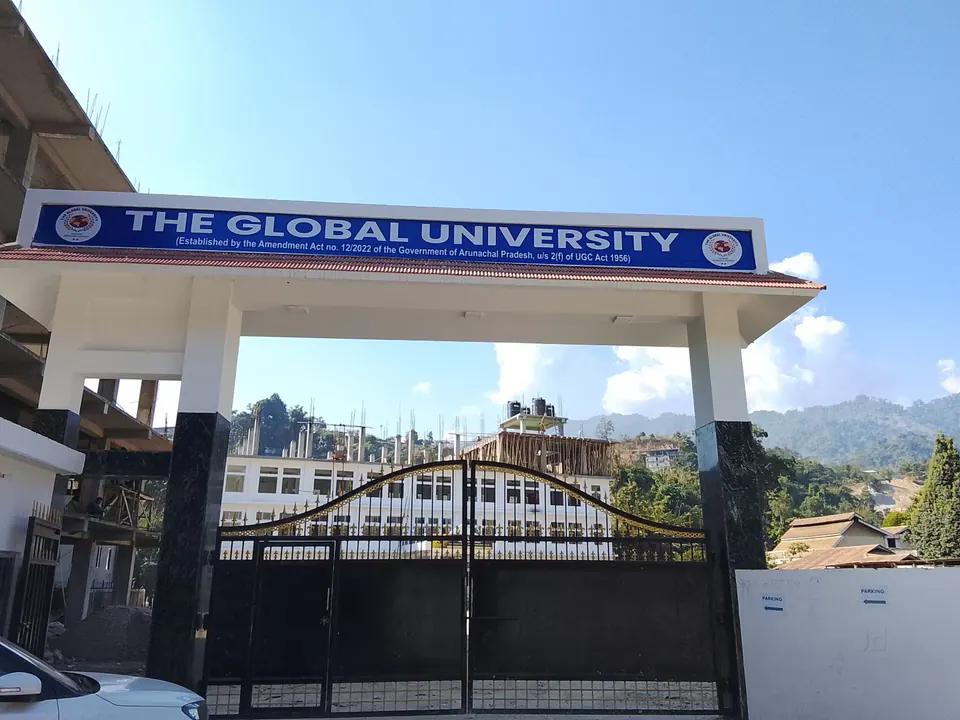
The Global University (TGU) is a State Private university situated in Itanagar, Arunachal Pradesh. University is offering higher education across diploma, undergraduate, postgraduate, and doctoral levels.
The Global University derives its operational authority and academic validity from the following statutory bodies and regulatory councils
 Government of Arunachal Pradesh
 NCTENational Council for Teacher EducationFor teacher training and education programs (B.Ed, D.El.Ed).
 INCIndian Nursing CouncilFor nursing and allied health science tracks.
 UPSCUNION PUBLIC SERVICE COMMISSION
 UGCUniversity Grants Commission
 AIUAssociation of Indian Universities
 BCIBar Council of IndiaFor legal education programs (LL.B, BA LL.B).
 PCIPharmacy Council of IndiaFor pharmacy courses (D.Pharm, B.Pharm).
 ICARIndian Council of Agricultural Research
Get clear answers and a plan that fits your goals.
 An UGC Recognized Program
Get guidance on B-Tech Credit Transfer process and next steps.
To all your degree admission queries
EduAcharya provides independent education counselling to help students explore overseas study options after their B-tech or degree credit transfer journey.
Discuss courses and universities in the UK, Ireland, Australia, New Zealand, Germany (private universities), Malta, the Netherlands and the UAE. We help you compare published entry requirements with your academic background, interests and budget.
Our services focus on course selection, university application guidance, general student visa information and pre-departure planning. Requirements and deadlines vary by institution and destination.

Explore university and course options based on your academic profile, interests and budget. We explain published entry requirements to help you prepare a shortlist. Each university assesses eligibility and makes its own admission decisions.

Get guidance on university application requirements, organising academic documents and understanding any offer conditions. Universities issue offer letters at their discretion; we do not guarantee an offer or admission.

We help students understand published student visa requirements, organise supporting documents and find official application information. Our role is guidance only: students complete and submit their own applications through official channels. Visa decisions rest with the relevant authorities, and approval is not guaranteed.

Discuss accommodation options, travel planning and adjusting to life overseas. Our briefings help you identify practical next steps; students arrange their own bookings and check current travel and entry requirements with official sources.
Fees explained. University and course selection guidance and university application guidance are free for all students. University application fees, tuition, government visa fees and other third-party costs are separate and payable to the relevant providers.
Independent guidance only. EduAcharya is not affiliated with, authorised by or certified by any government or embassy to provide visa services. We do not issue visas, verify documents on behalf of authorities, or file or submit visa applications for students. Admission, offer letters and visa approval are determined by the relevant institutions and authorities.
Global Reach
University and course guidance across eight study destinations.
Application preparation guidance to help you understand requirements and organise your documents.
Personalized Mentorship, Tailored advice aligned with your unique academic background and long-term goals.
Clear guidance on published requirements, application steps and decisions made by universities and authorities.
To all your degree admission queries
Explore the essentials of credit transfer, from eligibility to your final degree.
Inter-university credit transfer is an academic mechanism that allows a student to transfer the academic credits earned at one recognized university (the source/home institution) to another university (the target/host institution). This prevents you from having to repeat subjects or modules you have already successfully completed.
The Academic Bank of Credits (ABC) acts as a virtual repository that securely stores a student's academic credits earned across different institutions. Universities registered under the ABC framework can digitally verify, redeem, and transfer your stored credits when you move between institutions.
Eligibility generally requires that you:
Yes. If you dropped out after completing at least one or two semesters, you can apply for a credit transfer to resume your degree at another university.
You typically need to submit:
No. Credit acceptance is strictly subject to the host university's evaluation. Credits only transfer if the host university finds at least a 70% match in course content, learning outcomes, and credit weightage.
Yes. Most regulatory bodies and universities cap credit transfers—often allowing a maximum of 40% to 50% of the total degree credits. The target university usually mandates that you complete at least 50% of the total credits directly at their institution to grant you their degree.
If a course at your old university carried fewer credits or hours than the equivalent course at the new university, the host institution may either:
Generally, no. You can only transfer credits for subjects in which you achieved a passing grade or higher. Failures or pending backlog papers cannot be transferred.
In most systems, transferred courses count toward credit accumulation only—the letter grades or marks earned at your previous university are not factored into your new CGPA. Your final CGPA is calculated solely based on the courses completed at the host university.
Yes, but with limitations. General education courses, basic sciences, or elective credits will likely transfer. However, core major credits will only transfer if your new major shares equivalent prerequisite coursework.
Yes, provided both institutions are recognized by the relevant educational authorities (e.g., UGC, DEB, AICTE, or regional accreditation bodies) and both follow a compatible credit framework.
Yes, via international articulation agreements or credential evaluation services (such as WES or ENIC-NARIC). Foreign universities evaluate your transcripts to establish course equivalency before issuing credit exemptions.
The evaluation typically takes anywhere from 2 to 6 weeks, as subject experts from academic departments must manually compare and approve syllabi.
It depends on the host institution's fee structure. Most universities do not charge per-credit tuition for transferred modules, saving you money. However, some institutions may charge a fixed administrative "Credit Transfer Processing Fee."
Your official final transcript will explicitly list transferred credits and the originating university. However, the degree diploma itself is issued standardly by the host university without highlighting the transfer.
Generally, no. Employers and graduate admissions boards focus primarily on your final degree, skills, and overall performance. Having a clear transcript explaining your academic path is completely acceptable.
You can submit a formal academic appeal to the university's Registrar or Equivalence Committee, providing assignments, or detailed course catalogs to demonstrate subject overlap. If rejected permanently, you will have to enroll in those courses at the new institution.
Don't lose academic credits. Check credit eligibility.
Start your journey today, register in thirty seconds